
table of contents
- Understanding TAXP010
- Free Zones for Corporate Tax Purposes
- Designated Zones for Corporate Tax Purposes
- Designated Zones for VAT Purposes
- Designated Zones for Excise Tax Purposes
- Corporate Tax Implications for Distribution Businesses
- What Happens if a Business Loses QFZP Status?
- What Businesses Should Review
- Conclusion
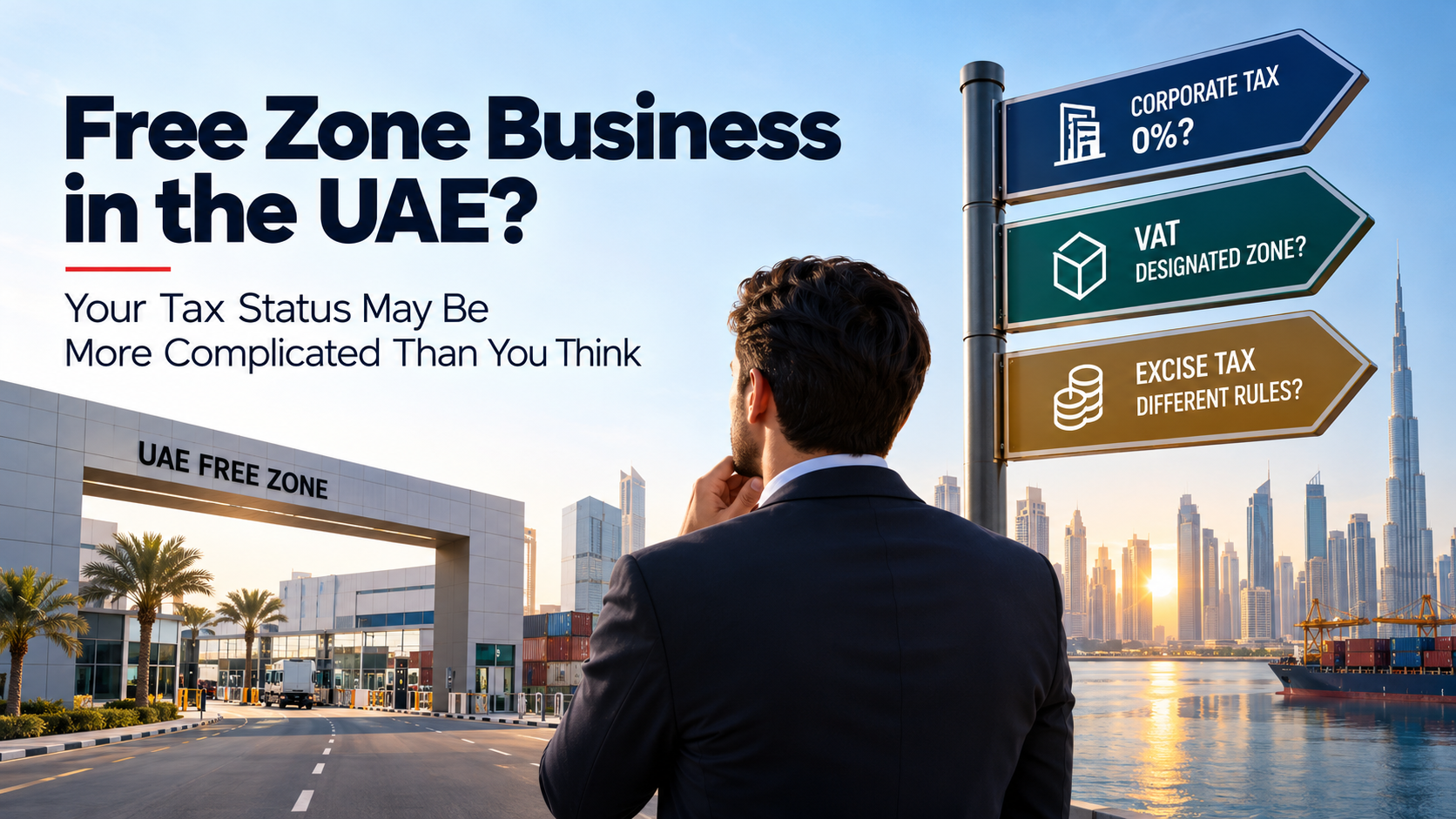
The Federal Tax Authority (FTA) has issued a clarification explaining how Free Zones and Designated Zones are recognised under the UAE’s Corporate Tax, Value Added Tax (VAT), and Excise Tax frameworks. The clarification highlights important differences between the three tax regimes, particularly for businesses seeking Qualifying Free Zone Person (QFZP) status and companies involved in distribution activities.
Published: 30 October 2026 | Category: Tax Updates & Compliance
Understanding TAXP010
On 2 October 2026, the Federal Tax Authority issued Tax Public Clarification TAXP010, titled Free Zones and Designated Zones for Tax Purposes.
The clarification addresses the different definitions of Free Zones and Designated Zones under UAE tax legislation.
A business operating in a Free Zone should not automatically assume that its location qualifies as a Designated Zone for every tax purpose. Each framework has its own classification criteria and compliance requirements.
TAXP010 explains four relevant classifications:
- Free Zone for Corporate Tax purposes.
- Designated Zone for Corporate Tax purposes.
- Designated Zone for VAT purposes.
- Designated Zone for Excise Tax purposes.
The clarification interprets existing legislation and does not independently introduce a new tax exemption or amend the underlying tax laws.
Free Zones for Corporate Tax Purposes
Under the UAE Corporate Tax Law, a Corporate Tax Free Zone is a designated and defined geographic area within the UAE specified through a Cabinet decision issued at the suggestion of the Minister.
Businesses incorporated, established, or registered in these areas may qualify as Qualifying Free Zone Persons (QFZPs)if they satisfy the applicable legal conditions.
A QFZP may benefit from a 0% Corporate Tax rate on its Qualifying Income. However, Free Zone registration alone does not guarantee this treatment.
Businesses must satisfy the requirements under Article 18 of the Corporate Tax Law and the relevant Cabinet and Ministerial Decisions, including the conditions relating to qualifying income, adequate substance, transfer pricing, audited financial statements, and the applicable de minimis requirements.
Designated Zones for Corporate Tax Purposes
TAXP010 clarifies that a Corporate Tax Designated Zone must satisfy two separate conditions:
- It must be recognised as a VAT Designated Zone.
- It must also qualify as a Free Zone under the Corporate Tax Law.
Both requirements must be met.
This distinction is particularly important for Qualifying Free Zone Persons involved in distribution activities. A business operating in a VAT Designated Zone cannot automatically assume that its location also qualifies as a Corporate Tax Designated Zone.
The relevant classification should be confirmed with the respective Free Zone authority.
Designated Zones for VAT Purposes
For VAT purposes, a Designated Zone is an area included in the list established under Cabinet Decision No. 59 of 2017and its amendments, provided it meets the conditions in Article 51(1) of the VAT Executive Regulation.
These conditions include:
- The area must be a specific fenced geographic location.
- Security measures and customs controls must monitor the entry and exit of individuals and the movement of goods.
- Internal procedures must regulate the keeping, storage, and processing of goods.
- The zone operator must comply with the procedures prescribed by the FTA.
Certain supplies and movements of goods involving Designated Zones may receive special VAT treatment, subject to the applicable conditions.
However, services supplied within a Designated Zone are generally subject to the same VAT rules applicable elsewhere in the UAE.
Businesses should therefore distinguish between goods and services when assessing their VAT obligations.
Designated Zones for Excise Tax Purposes
Excise Tax has a separate definition and set of requirements for Designated Zones.
Under Article 15 of the Excise Tax Executive Regulation, a qualifying area may include a fenced Free Zone that meets the prescribed conditions, including:
- Security measures restricting the entry and exit of individuals and the movement of Excise Goods.
- Control and supervision by a customs department.
- Appointment of a Warehouse Keeper responsible for the fenced Free Zone.
Other geographic areas may also qualify if they are specified by the FTA and meet the applicable security and Warehouse Keeper requirements.
Businesses should confirm their location’s status with the relevant Free Zone authority or Warehouse Keeper and verify whether the specific area has been approved by the FTA.
Corporate Tax Implications for Distribution Businesses
One of the most important aspects of TAXP010 concerns distribution activities carried out by Qualifying Free Zone Persons.
Under Ministerial Decision No. 229 of 2025, the distribution of goods or materials in or from a Designated Zone is recognised as a Qualifying Activity, subject to the applicable conditions.
TAXP010 clarifies that, for this purpose, the relevant location must qualify as a Corporate Tax Designated Zone.
This means that the location must be recognised under both the VAT and Corporate Tax frameworks.
The distribution activity must also satisfy the requirements prescribed under the relevant legislation. These include conditions concerning the importation of goods into the UAE, the nature of the customers, and the subsequent supply of goods.
Qualifying customers may include persons who:
- Resell the goods or materials.
- Process or alter them for sale or resale.
- Are public benefit entities.
Businesses should assess their actual distribution arrangements rather than relying solely on their trade licence or Free Zone registration.
Where all applicable conditions are met, a QFZP may benefit from the 0% Corporate Tax rate on the relevant Qualifying Income.
What Happens if a Business Loses QFZP Status?
Maintaining QFZP status requires continuous compliance with the applicable Corporate Tax conditions.
Under Article 5(2) of Ministerial Decision No. 229 of 2025, a QFZP that fails to meet the conditions prescribed under Article 18 of the Corporate Tax Law and the relevant decisions ceases to qualify from the beginning of the relevant Tax Period and for the following four Tax Periods.
This may affect the company’s eligibility for the 0% Corporate Tax rate on its Qualifying Income.
Businesses should therefore regularly review their activities, income sources, operating locations, and supporting documentation to ensure that they continue to satisfy the applicable requirements.
What Businesses Should Review

Following the publication of TAXP010, businesses operating in Free Zones and Designated Zones should consider the following:
- Confirm the classification of their operating locations separately for Corporate Tax, VAT, and Excise Tax.
- Check the FTA’s published list of VAT Designated Zones.
- Obtain confirmation from the relevant Free Zone authority regarding Corporate Tax classification.
- Review whether distribution activities meet the requirements under Ministerial Decision No. 229 of 2025.
- Assess the VAT treatment of goods and services.
- Verify the security, customs supervision, and Warehouse Keeper requirements where Excise Tax applies.
- Maintain relevant licences, approvals, customs records, and supporting documentation.
Businesses operating from multiple locations should assess each location separately rather than assuming that the same tax classification applies throughout their operations.
Conclusion
TAXP010 highlights the importance of understanding the different definitions of Free Zones and Designated Zones under the UAE’s Corporate Tax, VAT, and Excise Tax frameworks.
For businesses operating in these areas, the classification of their location can influence their tax treatment, particularly where Qualifying Free Zone Person status and distribution activities are concerned.
Businesses should review their operating locations and activities against the relevant legislation and obtain confirmation from the appropriate authorities where necessary.
Understanding these distinctions can help businesses maintain accurate tax positions and avoid relying on a classification that may not apply to their specific circumstances.
Disclaimer: This article is for general informational purposes only and does not constitute tax or legal advice. The applicable UAE legislation and official FTA guidance should be consulted when assessing individual business circumstances.
Official References
- Federal Tax Authority – TAXP010: Free Zones and Designated Zones for Tax Purposes (October 2026)
- Ministry of Finance – Ministerial Decision No. 229 of 2025: Qualifying Activities and Excluded Activities
- UAE Legislation – Cabinet Decision No. 37 of 2017: Excise Tax Executive Regulation

